
P versus NP – An early encounter
My first programming experience was in the early 80’s. I had bought myself a Texas Instruments 58-c programmable calculator, and was curious what could be done with such a device. That turned out to be very modest.
The calculator was capable of 480 program steps but held then zero memories for data storage.
Each memory used for data consumed 8 program steps, so with the storage of e.g. 10 integers, the programming space was diminished by 80 steps.
The 58-c’s memory was retained even after switching off the calculator, but before creating another program, the memory first had to be erased.
Note:
This article is part of a series of articles. Please check here for the other articles in this series and the best order in which to read them.
My TI 58-c was a cut-down version of the TI 59, which was more sophisticated. The 59 had twice the memory space, and it had a magnetic card reader for saving the precious program.
Of course, I would prefer these fine qualities, but unfortunately my budget was insufficient.
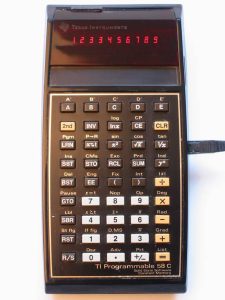
Anyway, my newly acquired calculator was a nice device, and with it came a manual with some programming examples. The first one I tried was a calculation of my biorythm. I hadn’t the slightest idea what someone’s biorythm represented, but this was nicely explained in the booklet as “… people’s daily lives are significantly affected by rhythmic cycles with periods of exactly 23, 28 and 33 days, typically a 23-day physical cycle, a 28-day emotional cycle, and a 33-day intellectual cycle”.
I typed in the full example, fired the application, and promptly found that on that particular day, all three of my personal cycles coincided at their absolute lowest values.
This observation didn’t discourage me from proceeding with the second example: a program for testing a given natural number for being prime.
I studied the algorithm which had a straightforward approach. The number to check (the dividend) was tested for being odd and from there on divided by every odd number starting with 3.
When the outcome of this division had a remainder, the divisor was raised by 2, and the loop continued with the next attempt. This iteration went on until the square root of the dividend was reached or no remainder was found, whichever came first.
When division by the truncated root still had a remainder, the number to check was labeled as prime.
Note that this iteration does not have to go beyond the square root; if there exists a bigger factor than the root, a smaller factor would have been found earlier.
I tested some numbers, prime candidates, and was not surprised to find that the time it took to find a prime was proportional to the size of the number.
Finally, I tested the number 1.000.000.021, another candidate in my opinion.
This turned out to be correct, and it took my calculator 20 hours! to deliver this result.
I know, this isn’t very impressive, but it still is a whole lot faster than I could have done it, armed with pencil and paper.
For the sake of confirmation, I fed my calculator with a next candidate: 1.000.000.033, and again it took the device 20 hours to label this number as prime.
It occurred to me that multiplying my two primes (1.000.000.021 x 1.000.000.033) was a breeze.
Even done with pencil and paper. The answer is 1.000.000.054.000.000.693, slightly more than 1018.
But how long will it take to factorise this number when we don’t know its factors upfront?
Our simple algorithm from earlier could stop checking the number 1.000.000.021 when it reached the square root of it: 31.622. It had iterated 31.622/2=15,811 times.
The two test primes are about equal and therefore their product 1.000.000.054.000.000.693 has to be checked up-to nearly the square root of it: 1.000.000.027. In fact, the algorithm will find the first factor 1.000.000.021 just before it reaches this final step.
The number of iterations for this calculation is 1000000021/2 = 500 000 010
which is 31.623 times the number of steps of the previous calculation.
So, for a prime in the proximity of 1.000.000.054.000.000.693 would take much, much more time to confirm its primality than for our prime number 1.000.000.021. Roughly about 30.000 times as long.
Decades after my Texas Instruments attempt, I did a similar calculation on a MacBook Air.
I created a simple program, entered the familiar prime number 1.000.000.021, and got this output:
Candidate 1.000.000.021 is a prime number
Number of iterations: 15.810
Elapsed time (milliseconds) 0
and
Candidate 1.000.000.033 is a prime number
Number of iterations: 15.810
Elapsed time (milliseconds) 0
The program could not express the calculation time in milliseconds, so I proceeded with their product.
Multiplying my two primes 1.000.000.021 and 1.000.000.033 gives 1.000.000.054.000.000.693, which is slightly more than 1018. And as I stated earlier, since these factors are about equal, the check would take the same time as any prime number in the vicinity of our target.
This came out:
Candidate 1.000.000.054.000.000.693 is not a prime number
First factor: 1.000.000.021
Number of iterations: 500.000.010
Elapsed time (milliseconds) 6.172 = about 6 seconds
This calculation took 31.625 times the number of steps used by the original test number 1.000.000.021 and it would have taken the old Texas Instruments more than 72 years.
Speaking about progress…
Abundantly I also must point out that our integer number system is characterized by unique factorization. A non-prime number has one unique array of factors; there is no other way in which this non-prime can be factorized.
So what do we have here?
On the one side, we have two prime numbers that we can multiply in less than no time into a number as big as 1018.
On the other side, it takes a modern computer a significant time (6 seconds on my Intel-based Mac) to check a prime near 1018 for being prime. A time that for this algorithm increases as O(√n) as we will learn in a later chapter.
It is extremely hard to factorize a big number, but when done, it is very simple to obtain the original number from these factors.
This was my first encounter with the P vs NP problem.
P vs NP
There is a movie that has the P vs NP problem as a main theme: The Traveling Salesman.
I haven’t seen this movie, but I assume that in the plot, not much time is reserved for going into depth about the matter. Also, in The Imitation Game, a film about Alan Turing, the problem may be mentioned briefly.
Wikipedia explains the rather mysterious subject as:
The P versus NP problem is a major unsolved problem in theoretical computer science. In informal terms, it asks whether every problem whose solution can be quickly verified can also be quickly solved.
Then, Wiki put this somewhat into perspective:
The informal term quickly used above means the existence of an algorithm solving the task that runs in polynomial time, such that the time to complete the task varies as a polynomial function on the size of the input to the algorithm (as opposed to, say, exponential time).
Publications about this problem often speak of P = NP or P ≠ NP.
There still is no proof of one or the other, so it is safer to write P vs NP.
Now, what do these P and NP actually mean?
Both concepts are defined in computer science, where they represent the class of complexity of the problems to be solved.
P is the class of problems where a problem is solved in polynomial time, and let us assume this means “quickly solved”. I’ll come back to this later.
NP is the class of problems for which the result of the solution can be checked relatively fast.
Of course, this means that every problem in P is also in NP. When a solution can be found quickly, it can also be checked quickly
So P stands for Polynomial time, which isn’t too bad in terms of complexity of the solution.
kn2 + 4n is an example of a polynomial. Solution time rises when the input (n) of a problem increases but it doesn’t rise dramatically. The coefficient k is some fixed number, and it expresses the overhead and efficiency of the algorithm.
Problems that are solved in exponential time, are much worse off. Here we find the input n as an exponent in the complexity expression, like kn + 4n. Imagine what this means when n = 1.000 or n = 1.000.000.
NP stands for Nondeterministic Polynomial time, Non-Polynomial time for short.
Wiki says this about nondeterministic polynomial time:
A nondeterministic Turing machine can move to a state that is not determined by the previous state. Such a machine could solve an NP problem in polynomial time by falling into the correct answer state (by luck), then conventionally verifying it. Such machines are not practical for solving realistic problems but can be used as theoretical models.
Now that is not much of an explication.
It is as if the mathematicians did their best to make the stuff as incomprehensible as possible.
Searching along on the internet, I found a better explanation. Here it is in my own words:
Think of a huge maze where you are in the center and must find the way out.
The maze is well structured, and you have an instruction set that describes how to proceed. This is the set:
Go straight until the third intersection, then turn right. After that, turn left at the second intersection. Then repeat these steps until you are out of the maze.
This maze problem belongs clearly in the P class since it ‘quickly’ can be solved in polynomial time.
Then we have a maze that seems totally without structure. Every turn and intersection is absolutely random; many corridors are dead ends. Now we deal with a nondeterministic polynomial-time problem. It is a continuous trial and error, and we need luck in our choices to get out. We can ‘check’ the maze in both cases quickly once out, by leaving marks during our outward tour behind or by unwinding a coil of wire when advancing. So this one belongs in the NP class.
The NP classification doesn’t stop here. We can read further on the topic:
NP-Complete.
Mathematicians can prove that some NP problems are NP-Complete. An NP-Complete problem is at least as difficult to solve as any other NP problem. This means that if someone found a method to solve any NP-Complete problem quickly, they could use that same method to solve every NP problem quickly. The Traveling Salesman problem is NP-Complete. Once a simple solution is found for it, every other NP-Complete problem can be easily solved along the same line.
NP-hardness.
This is the defining property of a class of problems that are informally “at least as hard as the hardest problems in NP”. A simple example of an NP-hard problem is the subset sum problem.
The discussion about these topics becomes very technical, and this is not the place to cover all the sophisticated science.
Instead, I want to proceed with the problem I bounced into with my TI 58-C programmable calculator: splitting up a large integer in its prime factors.
Integer factorization
I have already shown that testing a large number N for being prime or factorizing it in it’s prime factors is not a mean feat.
My simple algorithm did this by trying to divide the number by every odd number smaller than the square root of N. This method is called Trial Division.
Mathematicians say the Time Complexity of this algorithm is O(√n).
The O stands for the Big O function, which determines an upper boundary for a given function.
Of course, we can easily enhance the Trial Division somewhat. For example, divisors that have 5 as last digit can be skipped. And when a division does not deliver a factor, all multiples of this divisor up to √n can be sieved out.
Pollard’s Rho Algorithm has a Time Complexity of O(∜n), which is much better than (even our enhanced) trial division.
Currently, the General Number Field Sieve (GNFS) is the fastest known algorithm for factoring large numbers.
Its Time Complexity is 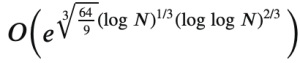
WolframAlpha calculates that for a number near 22048, about 1.35×1035 iterations are required.
This is much better than the Pollard-Rho algorithm (1.3 x 10154 iterations, but it is still a formidable number of iterations.
Anyway, even with these fairly optimized algorithms, factorization remains a cumbersome job.
This feature is of great importance for the security of our encrypted data.
We are reassured by the security experts about the encryption technology:
With existing computing technology, one estimate holds it would take 300 trillion years to “brute force” an RSA 2048-bit key.
However, the security experts continue with:
A perfect Quantum Computer could do this in 10 seconds.
And that makes a massive difference. A quantum computer with 4099 perfectly stable qubits could break the RSA-2048 encryption in 10 seconds (instead of 300 trillion years – wow).
We may conclude from this that factorization certainly doesn’t belong in class P since there is nothing ‘quick’ in a timescale of 300 trillion years needed for a 2048-bit number.
Forget about peeking in the quantum computer method and learning its algorithm. The shady world of quantum particles and waves is not accessible. The fragile cubits collapse the very moment they are observed. Giving nothing away.
It is also clear that factorization belongs in class NP since its result can easily be verified in polynomial time.
And then to think that there are many tougher (more computationally intensive) problems than factoring, e.g., the traveling salesman problem, and most graph-covering problems.
I asked ChatGPT on how to scale factorization, and this was his answer:
The best-known classical algorithms for this task, such as the General Number Field Sieve, have a runtime that is sub-exponential but still super-polynomial. This means that they are faster than brute force methods that take exponential time, but still slower than polynomial time methods.
There is still a group of mathematicians who believe that P = NP. They think that when a result can be quickly verified, there always exists a solution equally simple but that we just don’t know about it. And as I tried to explain, once a solution for an NP-complete problem has been found, all NP-complete problems are tackled. That’s why this group struggles to find the holy grail.
The group of non-believers, the ones that say N ≠ NP is much bigger.
One of their arguments is: A solution for at least one of those problems would have been found long ago. Since the greatest minds have tried. But in vain.
And another (most remarkable):
This isn’t how it works in real life. There isn’t one divine solution that covers them all. We have to struggle for each one of them.
I can live with that.
Eef
2023-11
Sources:
Internet global, Wikipedia, and an occasional question at ChatGPT. The AI came up with the maze example.
Notes:
Time complexity once more
The main difference between a polynomial and an exponential function is that with a polynomial, the (input) variable is raised to a power. On the other hand, with an exponential function, the variable is the exponent.
Polynomial vs exponential?
an3 + bn2 + cn + d —> polynomial
an —> exponential where n is the number of elements in the solution’s algorithm.
A polynomial based solution is much preferable over the exponential steps. Example:
an5 gives with n = 100 and a = 3 —> 3 x 1010 = 30.000.000.000 steps but 5n ≈ 7,9 x 1069 steps
Eef
2023-11
Author’s note
Entirely in the style of The Hitchhiker’s Guide, I am adding a fourth part to my trilogy of math articles as published in Paul’s blog.
The objective is like the previous three: trying to explain complex stuff in simpler terms than can be found on the internet.
This time it is about a somewhat foggy subject that is far removed from everyday reality, but is occasionally mentioned in some film: P vs NP, a major unsolved problem in computer science.
I gave it a try, and I hope that I can shed some light on the matter with this presentation.
Eef
2023-11
Editorial comment:
Admittedly, and not being much of a math wizz myself, I had to look up a number of concepts (a lot!) mentioned above. I found the following sites to be helpful:
- The Traveling Salesman problem
- Time complexity
- Or, more specific: Polynomial time
As well as these YouTube video’s:
- Computerfile – P vs NP (with Simon Singh)
- Haberdashery – P vs NP
Paul
2023-11
Click here for all math essays on this site