
Sometimes you’re out somewhere without access to your tools, and the car lets you down.
What now?
This happened to me while in Spain. We were in the car, planning to drop off my wife to a shopping center and me continue to the MOT station (ITV). The cluster lit up, the starter motor attempted to start the car, but to no avail. After a few very slow turns of the engine, there was no more juice left in the battery to finish the job. There went afternoon plans out the window, no shopping and no MOT. What now?
Our car is a 2009 Renault Scenic III 1.9 turbo diesel. It comes with every option known to mankind – and then some – available.
The obvious and structured way to tackle this would be:
- Charge the battery
- Run a battery diagnostic tester
- Start the engine
- Check if the engine is charging the battery
The values of the measurements should determine what is trhe problem.
As the Renault is our holiday car, I do not have a battery charger or starter cables. Only a limited set of basic mechanical tools are available, as is a very cheap digital multimeter.
So, I tried to get hold of a neighbor with starter cables to get the engine running. Then I can check if the generator was the culprit, or that we just had a dead battery. No luck. It is quite quiet at our holiday address currently.
Considering the car ran fine the days before, albeit perhaps being a slightly slower starter than usual, and the fact that no engine or charging light was on, and the voltmeter in the USB charger had constantly shown voltages of over 13 volts, my money was on the battery.
With no starter cables and a car to use them with available, it was time to make an executive decision:
New battery or not?
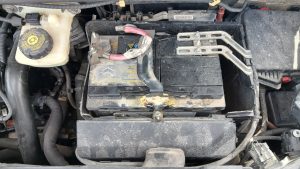
One of our neighbours came to have a look. He offered to push-start the car, which I kindly declined. Our car is a very heavy car, and it being a diesel doesn’t make it an easy push-starter. Both my neighbour and I are in our sixties, and in my view, push-starting cars is for younger folks. At our age, we’re supposed to take it easy on your backs as you only got one and it has to last a while. We studied the old battery – I had removed its plastic cover – and concluded that it had been in that car for a number of years. As the car sits most of the year in long-term parking at the airport, which i really bad for a battery, the battery life is significantly reduced. Weighing all of this, I decided to put my money on a new battery.
Luckily, there’s fuel station about a kilometer from where we live. They used to have batteries for sale before, so perhaps they still do today! I scooted over and found they still did, they had three! One of these happened to be the exact size, had the poles in the right place, and was the correct capacity for our car.
Bingo!
In our Rrenault, the battery is placed under the hood and easy accesible – I’ve seen much worse. It is fixed to the car by two bolts holding a metal bracket. No other bracket, wiring looms or plastic covers were in the way. The bolts sit quite lower than the top of the battery, and not accessible by my limited toolset. So my next stop was the cheapo china shop around the corner. There I bought a set of pipe wrenches and a small quarter inch ratchet socket set. These tools went together for under €10, which is a good indication of the total lack of quality of the tools.
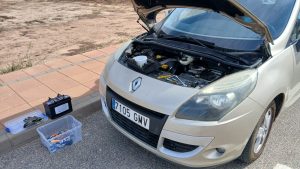
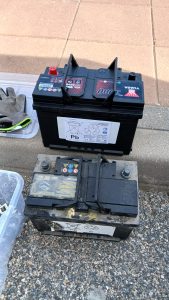
Removing an old battery works in 99% out of all cases using these simple steps:
- Remove any plastic covers that are in the way
- Remove the cable to the minus pole (always start with the minus pole!)
- Remove the cable to the plus pole
- Undo the bracket holding the battery in place
- Remove the battery from its holder
Mounting the new battery is simply the reversed order as taking it out.
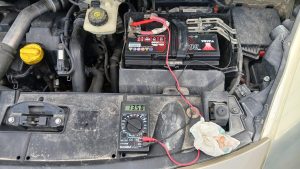
The removal of the battery and subsequent installation of the new battery was uneventful. After that, the car started and I finally could measure if the engine was charging the battery – and indeed it was.
Note:
This repair was perhaps rather trivial and simple, but I tried to make a point not to ‘intuitively’ replace parts without a proper diagnosis. Firing the parts cannon is never a replacement for diagnosing the car to find out what the real problem is. In this case, the diagnosis was not based on complex measurements, but by considering what went wrong and in what order.
Lessons learned:
- You can’t have all your tools with you all the time and anywhere
- Think!
- Do what you can with the tools that you have
- Improvise!
Note to self: Buy a set of starter cables (but not from the cheapo china shop!)
To be fair, any technical challenge more advanced or requiring more advanced tools would have meant a trip to the local workshop. There’s one down the road from where we live, so that’s assuring.
Paul
2026-10
Spain
This page is part of a series. You can find the main page for the series here.
#diagnosis #cardiagnosis #car-diagnosis #obd2 #obd-II #faultcode #ecm #bcm #felkod #youtube #batteryreplacement