
The clock shift
Spring is approaching.
The astronomical spring begins this year on March 20, when the sun is perpendicular to the equator.
Shortly after, the Middle European Summer Time will start: Sunday, March 29th.
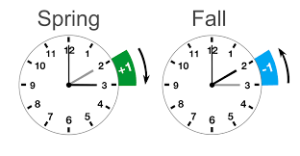
As we all know, on that date we have to turn the clock one hour forward.
In the meantime, this familiar procedure is preceded by an equally well-known concert of moaning, whining, and complaining by the opponents of tinkering with the clock.
The Dutch in particular sound the loudest in this symphony.
In 2021, procedures were to be started to get rid of the summer/winter time system for the EU member states. This was suggested in 2018 by the European Committee, as recommended by the then outgoing chairman Jean-Claude Juncker. The European Council(the government leaders) was supposed to take a final decision about this proposition, but up till today, that has not been done. Obviously, the subject is not high on the priority list,
so the jumps forward and backward twice a year will not disappear any time soon.
This, to the dismay of the anti-clock-shifters, and the traditional wailing will start one or two weeks before the event.
‘Sleep experts’ pop up from various directions and warn that the sudden timeshift of one hour heavily disrupts our biorhythm and can lead to serious health issues.
Multiple complainants declare that they remain out of balance until turning the clock back at the end of October.
The same affected people do not have the slightest problem with a weekend in London or a single week at Tenerife or Kreta. Even the real jetlag destinations like New York, Bali, and Crete are miraculously free of health issues, but for one or two days adapting discomfort.
No warnings from sleep experts here. No negative travel advice.
At the end of 2018, a short survey was conducted, requested by Minister Ollongren (D66), into what was the Dutch preference for this kind of time manipulation.
This resulted in (about):
– 40% in favour of permanent wintertime
– 30% in favour of permanent summertime
– 30% in favour of maintaining the present procedure.
The study was a demonstration of scientific illiteracy.
The composition and size of the group surveyed were kept unknown, but the in the Dutch news channels published the conclusion: “Vast majority of the Dutch people choose for permanent wintertime” is ridiculous, of course.
This should have been: “A limited survey among a group of Dutch people shows: 60% of the participants do not opt for permanent wintertime.”
In fact, merely a nationwide referendum can provide clarity about what ‘The Dutch’ want.
But as yet, the supporters of the permanent wintertime are the noisiest ones.
In their argumentation, they point out over and over that the wintertime clock shows the true time. That time gives us the sun at the highest position of its orbit at 12 pm.
Forwarding the clock by one hour eliminates this phenomenon.
How ‘true’ is the time actually?
Astronomy gives us an answer up to any desired detail level, and every astronomer knows how tricky it is to design a calendar that remains accurate for centuries, and which intermediate corrections are involved.
Day and night are based, of course, on the rotation of the Earth.
One rotation is completed when a distant star becomes visible again at exactly the same angle, a sidereal day of 23 hours and 56 minutes. But isn’t this exactly one day?
No, it was chosen to consider a rotation completed when the centre of the sun becomes visible again at the same angle, a synodic day.
This synodic day is a bit longer than the sidereal day because Earth meanwhile has advanced in her orbit around the sun and has to rotate a bit further to align to the sun’s centre. The sidereal day is increased this way by 4 minutes to a 24-hour day.
Together with the correctional leap day and a couple of smaller periodic alignments, this prevents getting noon in the middle of the night and from the gradual shifting of the seasons, and eventually celebrating Christmas in the summer.
Earth’s orbit isn’t a perfect circle with the sun at its exact centre; the orbit is slightly elliptical, which causes the orbital speed to vary a little. This speed is in the winter (the northern hemisphere winter), marginally higher than in the summer. This has consequences for our synodic day, due to the higher speed, the day length is a tiny bit longer in winter than in summer.
Fortunately, it was not chosen to vary the time system accordingly; our mechanical (analog) clocks would not have been able to handle this.
Our 24-hour day is based on the medium solar day, the average of the day length over a year. The fluctuation of the 12 pm position of the sun as an inevitable consequence is called the equation of time.
And come to think of it, even the reliable rotation of the earth around its axis isn’t as constant as we would have it. Variable earth rotation.
Much more important to us is the change in daytime length (daylight/darkness division), which is constantly changing, due to the tilted position of the earth axis.
The largest differences occur in the polar regions; near the equator, they are much smaller.
Locations at the same latitude have equal daylight hours. In Amsterdam, this is roughly 8 hours in midwinter and about 16 hours in midsummer.
With all these variations, corrections, and adjustments, the concept of ‘true time’ is, of course, just a myth. And what about the highest position where the sun is supposed to hang around at exactly 12 pm (equation of time ignored)?
Time zones
In the early days, that was indeed the case. Local time was tuned accordingly, and the clock was synchronised. Because the sun rises earlier in the east and sets later in the west, all these local times differed from one another with 24 times 60 divided by 360 is 4 minutes per degree longitude.
In the Industrial Era, with the development of faster East-West movements, it became increasingly problematic to maintain this situation, and the time zones were implemented.
The initial plan was to divide the Earth into 24 strips, each 15 degrees wide, with a time jump to the next zone of 1 hour. But soon came the insight that drawing straight lines from pole to pole, would be very impractical.
For geopolitical reasons, it seemed better to adjust the time zones by following regions and national borders, and there are now no fewer than 40 time zones in use.
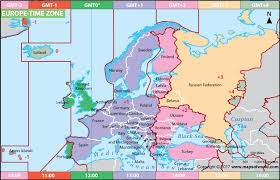
Anyway, the western border of the Central European Time zone (CET), aka Middle European Time zone (MET) touches Norway, Denmark, and drops to the Netherlands, France, and Spain.
To the east, the zone embraces Sweden, includes Poland, and drops all the way south to Albania.
This is a fairly wide strip.
The distance between Bergen, Norway, and Östhammar, Sweden is 723 km as the crow flies.
Between Amsterdam and Warsaw, it is 1.105 km, and between Madrid and Vlorë, Albania 1.975 km straight.
These distances give a strange effect. I chose those pairs for a reason: they are on the same latitude, which means they have a similar daylight length.
In Östhammar, however, the twilight begins 53 minutes earlier than in Bergen, in Warsaw 64 minutes earlier than in Amsterdam, and in Vlorë 1 hour and 33 minutes earlier than in Madrid.
Despite these large differences in sunrise and sunset timing, in all those places the clocks show the same time. So how is that for a ‘true time’?
And where do we find the sun at noon in this time zone? We may expect each zone to have a meridian that is ‘correct’, meaning that the solar noon occurs at 12 pm (due to the equation of time, the exact time is slightly fluctuating).
For the MET zone this meridian crosses Stockholm, passes through Budapest, and Tirana, Albania.
In fact, this is strange, in that this is located at the ‘eastern edge’ of the strip rather than in the middle. Which causes most countries in the zone to be more or less ‘off noon’. In otherwords, solar noon ‘is late’.
Is that bad? Do our sleep experts have a theory about this? Are people living close to the ‘true’ meridian is healthier than their more western-oriented counterparts because their time is ‘truer’?
Of course, business and political interests play a role in connecting across time zones. It is striking, however, that in both GMT and MET, the central meridian almost touches the right boundary. This insinuates that nobody wants to live east of the ’solar noon meridian’.
So it seems a deliberate choice to extend to the West as far as possible because this guarantees a later sunset. Spain, for instance, has its Costa Blanca East coast aligned with the Greenwich Zero meridian, which means that everything west of this coast – up to Portugal – is located west of London.
Put differently, Spain is part of the wrong time zone; it belongs to the GMT. But we saw earlier that countries have a free interpretation of the straight meridians that restrict the time zones.
Portugal does not follow Spain and settles for GMT.
The Dutch Summertime opponents yearly summon an astronomer to explain to the public how far off the solar noon position is so that they can suggest that this is the reason of their current imbalance. It is also emphasised that the annual spring clock shift makes this offset a lot worse, hence deepening the discrepancy.
In the meantime, the Spanish live really well beyond ‘their’ solar noon, and continue to enjoy the long sunny summer days.
Symmetry of the day
With the introduction of time zones, not much was left of this local ‘true’ time; in fact, the concept was thrown overboard.
Now the question remains: how important is this true solar noon time?
In earlier days, very important because the daily schedule of the people was based on it.
The peasant got up at the crack of dawn and went to work. Cultivating his land, milking the cows, taking wool from the sheep, seeding, harvesting, whatever a farmer was supposed to do. Short after sunset and his meal, he went to bed. Tomorrow, another tough day starts, and he needs all the available daylight for it.
This is still visible in the animal world. Birds don’t have an artificial clock but for the majority of them, their day is symmetrically distributed around the real solar noon.
The birds in Warsaw wake up earlier than the birds in Amsterdam and go to sleep earlier.
No clock, no summertime, no wintertime.
But how symmetrical is the day of modern mankind?
Well, this day looks entirely different. The average person wakes up at 7:00 and goes to sleep at 23:00. At a location of minimal deviating time (e.g. like Budapest or even purer, Greenwich), this daily schedule has 5 hours before noon and 11 hours after.
This is quite asymmetrical, I would say!
The sliding of an hour when crossing a time zone boundary or when Daylight Saving Time starts doesn’t make a lot of difference to this ‘symmetry’.
There is no need for mankind to sit in the dark, like our poor farmer in times past.
After dusk, artificial light takes over, and life continues full throttle.
Our dependance of daylight is with this achievement gone forever.
To shift or not to shift
Nobody, of course, wants to go back to the small-scale of local times and lose the advantages of an identical timeframe within the time zone.
But the ingenious idea behind the time zones with a common time would be fairly violated by fragmenting the strips into countries where DST is arbitrarily chosen.
It takes someone like the narrow-minded European Committee ex-chairman Juncker’s to present this ‘permission’ as his parting gift.
Currently, there are 31 countries in the MET zone and time coordination with the surrounding countries and the most important socio-economic partner countries is foremost required, which makes it extremely important that the time synchronisation remains intact.
This, of course, can also be achieved by choosing permanent wintertime or permanent summertime. Each of these choices has its disadvantages, and the simplest way to eliminate these is to maintain the present clock shifting.
Conclusion
Considering the relative indifference to get started with this file – after all it’s 8 years since Juncker’s proposal – and considering no action has been taken, we may conclude that there is sufficient consensus on the current situation.
The preference for long summer evenings is undoubtedly another – yet unspoken – reason.
The choice of the Dutch public – by result of a national referendum – can be studied but
cannot be decisive.
Eef
March 2026
Sources:
– Wikipedia
– physics.stackexchange.com
– timeanddate.com
Editorial comment:
If this article strikes you as deja vu, then you are partly correct. A similar article has been published earlier on this site, albeit in Dutch. However similar this article may seem at first glance to its Dutch counterpart, Eef has managed to surprise us with some new points of interest in this English article.
Paul
2026-02