
Electric vehicles, or EV’s for short, seem to be what we all need to drive in the future. At least if you believe the government and science. Our combustion-engined cars have done what they can; now we need to step up with better alternatives to limit polluting our atmosphere even more.
While I’m not a great admirer of EV cars, I do see their merits, foremost on the exhaust pollution aspect. That said, there are major downsides, partly with the cars and technology itself, partly with legislation. And of course, the elephant in the room: the way they are charged.
EV technology:
The use of lithium batteries seemed nice early on. But now it has become clear that lithium is controlled by a limited number of countries that have a sort of monopoly on the material and production of battery cells.
Apart from that, the lithium cells themselves have proven to be hazardous when damaged or exposed to heat. All bets are off when they finally catch fire, and nothing available to your local fire department can put out the fire. This is called a thermal runaway, a chemical process withing the individual battery cells. When it happens, there’s no fire extinguisher on the market today that you can use to stop it. The only remedy to a thermal runaway is a full car dip in a container filled with water. This dip may last hours or perhaps days, but lithium cells are known to be able to spontaneously reignite months later.
When the car has reached its end-of-life, it has to be recycled. While most of the vehicle can be processed as any non-EV car, the battery pack requires special attention. Up to 95% of the lithium and other metals can be extracted for reuse, albeit at a cost.
Legislation:
Within the EU, new legislation is added to new car requirements on almost a monthly basis. The latest being cameras monitoring the driver for signs of falling asleep that launched a month or so ago, and one in the making for 2027 that will force a driver to stick to the local speed limit.
Another mandatory system added years ago was TPMS, the Tyre Pressure Monitoring System. The TPMS checks for differences in tyre pressure as your car rolls down the road. It is, in my view, the worst ‘safety’ system made mandatory in the last few decades. But any added safety is always a good motive for improvement, right?
What most car buyers perhaps forget is that they’ll have to pay for these systems; they do not come for free and will be added to the already hefty price of your next new vehicle.
As for most of these ‘safety’ systems, if only drivers would do as they learned when taking their driver’s license, most of these systems would not be required. Safety is a behavior. Adding these features to the car almost provides the driver with a feeling that the car can be driven badly, and the electronics sort out the safety aspects as we go.
Charging:
As we regularly have to fuel up our combustion-engined car, the batteries in an EV need to be charged regularly. For this, you need a suitable power outlet. In your garage, on your driveway, or at a charging station in your neighborhood, or at a fast-food restaurant or regular fuel station. But ultimately, the energy used to power the EV has to be produced first. As it is today, most of this electricity comes from regular power stations powering the electric grid. And in large parts of the EU, this grid is already at its limitations today, capacity- and connection-wise.
Additionally, fueling up our old car took up to five minutes of our time; ‘fueling up’ our EV takes significantly longer. Here, you can calculate how long it will take for your EV.
In general:
- The higher the capacity of the EV’s battery pack, the longer it takes
- The lower the current of the charging station, the longer it takes
- The lower the state of charge of the battery pack is, the longer it takes
- But also: the more EV’s are already connected to the charging station, the longer it takes
The latter one obviously also is valid for our liquid-fueled cars, but there is only a waiting time of five minutes per car, as opposed to at least half an hour or likely longer per car. Different battery chemistries have been investigated for years to find a combination of elements that allows for more speedy charging. The illustrious Solid State technology, which we’ve been waiting for over a decade, could change this drastically.
EV downsides:
- Long charge time
- Not yet fully developed charging infrastructure
- Limited capacity on the power grid
- Too expensive due to mandatory ‘safety’ equipment (also valid for EVs and liquid-fueled cars)
General vehicle life span:
In the EU, we’re very bad at extending the lifespan of our cars. Our vehicles get more complex every year; they cost more to develop, build, maintain, and scrap. The only thing that seems to matter is adding that novel system that might improve safety by another primille. Often, as a result of insurance company policy or general unavailability or pricing of new parts, modern cars are scrapped much earlier than older generations of cars were. This is due to avoiding risks with complex electronics and networks after a crash – the lifespan of a modern car is shorter than it used to be with older cars. And this extends to EV’s also.
Previously, a car could be used for decades; now, already after only five to ten years, there can be a shortage of parts needed to keep our modern cars rolling.
Are there alternatives?
It seems to me that there could be a market for smaller, cheaper cars that perhaps might have a limited maximum speed, making them require less expensive safety equipment. This would lower the price for these new cars significantly, allowing more people to afford a new car.
Smaller cars also have other advantages, such as fewer materials required to build them, less impact on road wear, requiring smaller parking spaces, and needing less energy to move them around. But also: less battery capacity and therefore shorter charging time and less electricity required. And during use, having fewer expensive components built into the car implies that fewer things will break, which translates to lower cost of ownership.
An alternative:
At least one asian manufacturer:
https://www.solarkycar.com/
…has figured out how to make new EVs both affordable and less dependent on the electric grid. They introduced the Sun-V, a tiny car with solar panels on its roof and equipped with the bare minimum of driver assistance and control functions. When parked, the solar panel can be extended, doubling its area, and adding 55 kilometers to the range every day – obviously provided there’s enough sunshine.
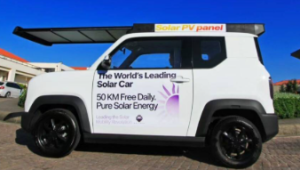
…the photo shows the Sun-V with the solar panel extended.
Another alternative:
Instead of throwing away small cars that have been used as a second or third car, one might consider electrifying them. There are many companies out there that will take your small car, take out the engine, and put in a custom-made EV package or a salvaged EV package from another car, and turn it into an EV.
Already today, the EV part of Nissan’s Leaf electric cars is a popular package to convert a liquid-fueled car into a full EV. This particular EV package was designed as a complete unit that can be easily extracted from a scrapped car. This modularity allows it to continue its life in another car, something that perhaps other manufacturers could learn from, and perhaps legislators could try to legislate manufacturers towards.
This form of recycling is, in fact, similar to a heart transplant, if you like. The very ill patient died, but his heart lives on in another patient. The ultimate recycle – not recycle for materials, but recycle for reuse. In my view, that’s where we should focus in the future.
Some considerations:
- How often do you drive your car with only one or two people in it?
- How often do you need the full range of 500+ kilometers as opposed to the perhaps limited range of a small EV?
Some examples of recent EU ‘safety’ regulations:
- ISA: Intelligent Speed Assistance
Warns for or restricts speeding based on road sign recognition or GPS data - AEB: Advanced Emergency Braking
Does an automatic emergency brake to avoid a collision with vulnerable road users - ELK: Emergence Lane Keeping
Steers the vehicle back when drifting off a lane - EDR: Event Data Recorder
A black box that records vehicle data and saves it when the vehicle is in a crash - RD: Reversing Detection
Backing camera or sensors - …there are more…
- Upcoming for 2027: Driver Distraction & Drowsiness Warnings
All of these systems require:
- Sensors to ‘see’ what’s going on
- A ‘computer’ to analyze the data from the sensors
- An actuator to intervene in the developing situation
- A network to have the above components ‘talk’ to each other
- Development costs for engineering the system
What do I drive?
Good question! My car of choice is a 1979 Citroën AcaDiane, a small panel van that seats two and sported no electronics when new. It sports a tiny 2-cylinder 30 HP air-cooled engine. As an elderly vehicle, it hasn’t got any of the safety features required on new cars today. It does come with safety belts, though! As a result, it is cheap, weighs very little, is easy on the fuel, pollutes little, is cheap in use, and it did cost little in CO2 emissions to produce back in the day, …

And yes, I drive that thing year-round. We live in Sweden, so winters mean months with lots of snow and ice. I have a set of studded winter tyres for my Acad, and it performs well with them. And my car is certainly more fun to drive than any modern car – imho.
Obviously, I’m a handy mechanic and don’t have to pay a workshop every time something doesn’t work as intended, which is surprisingly seldom! Less stuff means fewer things to break! These days, I exersize most of my mechanical skills on my Mobile Mechanic for Ukraine project; read more about that here. (The page is in Swedish, but translates well in your browser)

And no, in spite of the perhaps negative facts above, I’m not against EV’s at all. But I am convinced that the market provides mainly overly expensive cars that contain too much technology and unnecessary complexity. If I weren’t mechanically handy, I’d very much like to drive a car as the Sun-V mentioned above, or similar: nice on the environment, cheap in purchase and use. But as things are today, there are no reasonably priced EV’s on the market – at least not where we live.
Sources:
- google.com
- https://single-market-economy.ec.europa.eu/document/download/cd243af9-c877-401e-9f69-d7d4ab6a90c6_en?filename=Fact%20Sheet%20General%20Safety%20regulations_July%202024.pdf
- https://commission.europa.eu/news-and-media/news/safer-cars-safer-roads-new-rules-take-effect-2026-07-08_en
Editorial comment:
The article above received a comment worthy of its own article. You can find it here. Enjoy!
Don’t forget…
…to join our free service that sends you an email every time a new article is posted on this site! We only require your email address, and we don’t sell or abuse it in any way.