
In response to an article on electric vehicles I published recently on this site, my co-columnist Eef wrote a reaction – an editorial comment if you like. As it was more voluminous than your regular ‘Editorial comment’, and was also in itself a very interesting read, I decided to publish it as a separate article – which you can read below. Enjoy!
I agree with Paul that EV’s have their advantages.
There is no doubt in my mind that the modern electric motor is far superior to the internal combustion engine ICE, no matter how advanced the latter may be.
I picked a few of the superior qualities from the internet:
Much greater efficiency (90% vs 30%), half the size and weight, hardly any service maintenance, no CO2 exhaust, no gears, near-instant torque, silent operation, long life span.
These characteristics are so outstanding that the discussion is closed, you should say.
However, there is a major setback: the energy supply by batteries.
Compare the weight of a tank filled with gasoline with a pack of batteries with the same energy content. We’ll see a factor 10 difference!
And that’s just size and weight. Even worse is the time a refill takes. Half an hour until 80 percent of full load is common, and as Paul pointed out: that depends on the size of the battery. A longer range also means a longer charging time. On longer trips, people tend to charge even more frequently than required, fed by this new phenomenon ‘Charging anxiety’.
The fear of being stranded with an empty battery.
But what about the solid state battery with its superb characteristics, we keep hearing about? It seems to me that this, like energy from nuclear fusion, always will be somewhere in the future.
Furthermore, Paul rightfully claims that electric cars have to deal with massive problems in the field of infrastructure, which causes severe societal consequences.
In The Netherlands – I used to live there until 20 years ago – our political leaders, among who beta-thinkers are rare or even absent, were so enthusiastic when they heard about the environmental advantages of EV-cars that, without any further thinking, they jumped in with a program to heavily subsidise those and launched projects to provide the country with a network of charging stations of both low and high capacity.
In no time, the Dutch had the greatest charging points density in Europe.
Soon a nasty side effect became apparent: the main electricity grid was nowhere near capable of supplying the required power. Of course, more practical thinkers had long before commented on this wishful thinking approach.
This blog published my short paper https://www.allegedfacts.eu/2022/06/26/energievoorziening-in-nederland/ four years ago. No brilliant visions in there, just plain common sense.
Now what? Swap our cars for ones equipped with air-cooled two-cylinder engines, as Paul suggests?
I don’t think it will come to that. ICE’s however, will be among us quite some time and we can read that the ambitious EU plans to inhibit the sales of new ICE driven cars after 2035 became already a topic of discussion.
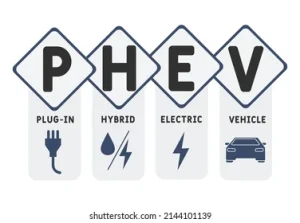
In the meantime, we can have the best of both worlds: hybrid cars.
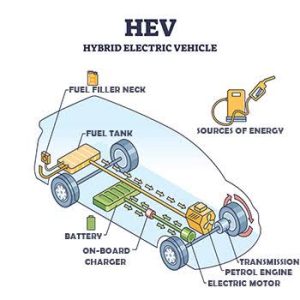
My present car is a Renault Symbioz with a drive system of an 110 hp ICE and a 50 hp electric motor powered by a 1.4 kWh battery. The electric motor is used alternately as a drive system and as a generator that charges the battery.
There is a lot of energy in a moving car.
When slowing down, stopping, or preventing the speed from coasting when going downhill, this energy needs to be shed.
Traditionally, this was done by stepping on the brake. The car slowed down, the brakes heated up and radiated the unwanted heat around, thereby increasing the entropy of the universe. Second Law of thermodynamics.
And what about lifting the foot from the gas pedal during a descent, which makes the car resist the eager acceleration?
That process doesn’t cause any heat, right? Wrong!
The internal combustion engine draws cool air into the cylinder, compresses it, and expels it. No explosive mixture here, so no combustion, just compressed air. And when you compress air (or any gas), it heats up. After the compression step, it is expelled and the hot gas leaves by the exhaust pipe. And again the entropy of the universe is increased.
The Second Law is ruthless. Energy can’t get lost, but it surely can be wasted.
But now we have hybrid cars. That offers us a solution to use the precious impulse energy instead of just radiating it away.
When lifting your foot off the accelerator pedal, the electric motor is switched into generator mode and starts charging the battery. This generator offers resistance to being driven, and that causes a slowing-down effect.
Later, the electric motor switches to propulsion mode, powered by the battery using energy that earlier was flushed out.
Most hybrid cars can adjust the level of resistance, resulting in a weaker or stronger brake effect.
And let us not forget that every EV uses the same energy-saving procedures.
Is there more to be gained from the energy abundance of a moving car?
What about this idea: make the shock-absorbing process electromagnetic and charge the battery with it.
Obviously, ICE-propelled cars will be around for quite some time. But they better be hybrid!
Eef
France
2026-07
Editorial comment:
While I largely agree with the points sketched above, there are a few that Eef and I differ on. In my view:
- An EV or hybrid battery with similar size and weight as a fuel tank holds (much) less capacity
- The great disappointment in EV battery development is indeed the Solid State technology. Toyota has announced it almost as often as the owner of Tesla has announced new technology. However, contrary to Eef’s vision on this point, I do think it will be released commercially within years, if not sooner.
- Before the reader decides I am on a quest trying to force ancient technique as 2-cylinder air-cooled engines upon you: I’m not. My point is that keeping on driving an old car is also a form of CO2 emission reduction as a result of the production of new vehicles. Obviously, such an old vehicle is emission-wise no match for a newer car model, but we ought to compare the full emissions during the complete life-cycle of each car.
- Living in Sweden for almost 30 years, we experience a similar lack of capacity as in the Netherlands to expand the electric grid to allow for charging stations wherever we please. And it should be easier in the Netherlands than in Sweden. A large portion of electricity is generated in the north of Sweden and then has to be transported to the south, where most people live, with rather high distribution costs for electricity as a result.
- The generator effect described by Eef that charges the battery instead of engine-braking can technically be done in two ways:
- by decoupling the engine and letting it idle
This is obviously no good as it will burn gas while idling as the electric motor charges the battery. - by allowing the engine to also engine-brake
This method is generally used in hybrid cars. But it still has the disadvantage that air is sucked into the engine and is compressed, thus absorbing a part of the brake energy. A device reducing the compression of the engine when engine-braking would strongly reduce that negative side effect. Unfortunately, it’ll add to the complexity of the engine construction and to the cost.
- by decoupling the engine and letting it idle
- The regulation of how much the car brakes when you release the accelerator pedal is referred to as ‘single pedal driving’. In some EV’s, the brake pedal is not needed anymore as speed – and reduction thereof – is regulated only with the accelerator pedal.
- Fun fact:
It is truly incredible that even when you’re driving your car on a sunny Sunday afternoon, you still cannot escape the harsh laws of thermodynamics. Being made aware of this, leisurely country tours may never be the same again.
Paul
Sweden
2026-07